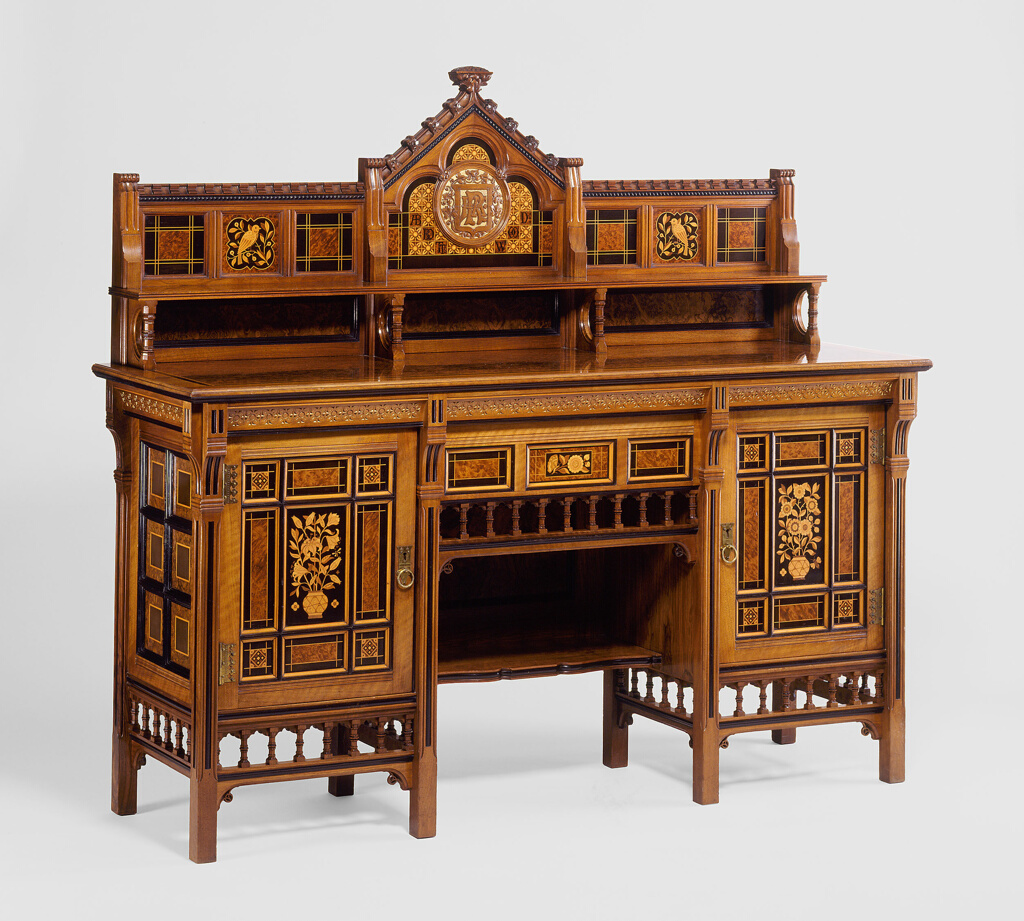
Drawing Room Cabinet
| Title | Drawing Room Cabinet |
|---|---|
| Artist | Designed by Bruce James Talbert Scottish, active in England, 1838–1881 Made by Gillow & Company England, 1730–1974 |
| Date | 1871/72 19th century |
| Medium | Walnut, ebony, boxwood, thuya, maple, and other woods, gilding, and lacquered brass mounts |
| Classification | case furniture |
| Origin | Lancaster Lancaster |
| Holding institution | Art Institute of Chicago |
| Credit line | Gift of the Antiquarian Society through the Mrs. Edgar J. Uihlein Fund |
| Rights | Public domain (CC0). Free to use for any purpose. |
About this artwork
“Drawing Room Cabinet” is a work by Designed by Bruce James Talbert Scottish, active in England, 1838–1881 Made by Gillow & Company England, 1730–1974, dated 1871/72. It is executed in walnut, ebony, boxwood, thuya, maple, and other woods, gilding, and lacquered brass mounts and classified as case furniture. This work is in the public domain (CC0), so the image may be downloaded and reused for any purpose without permission (see the licence note below).
Explore the context
The artist
This work is attributed to Designed by Bruce James Talbert. Browse every catalogued public-domain plate by this maker.
The period
Dated to 1871/72. Explore the wider set of works from the 19th century held in the archive.
The origin
Recorded origin: Lancaster. Browse more public-domain art from Lancaster.
The collection
Made available through the Art Institute of Chicago open-access programme, which explicitly places this work in the public domain.
Keep exploring
Zoom out
- /browse Browse the whole archive
Download this image
Rights: Public Domain — CC0 via the Art Institute of Chicago Open Access programme.
This work is in the public domain. You may download the image and use it for any purpose, personal or commercial, without permission or payment. No attribution is legally required, though a credit to Art Institute of Chicago is appreciated.
Prefer a themed set as a single ZIP with a manifest? See the image packs. The works remain public domain / CC0 whichever way you take them.
US vs EU note: in the United States a faithful photographic reproduction of a public-domain 2-D artwork carries no new copyright (Bridgeman v. Corel), which is the basis of these open-access programmes. EU Directive 2019/790 Art. 14 similarly provides that reproductions of public-domain visual works are not protected. If reusing commercially in another jurisdiction, satisfy yourself of the local position. See the full licence note.