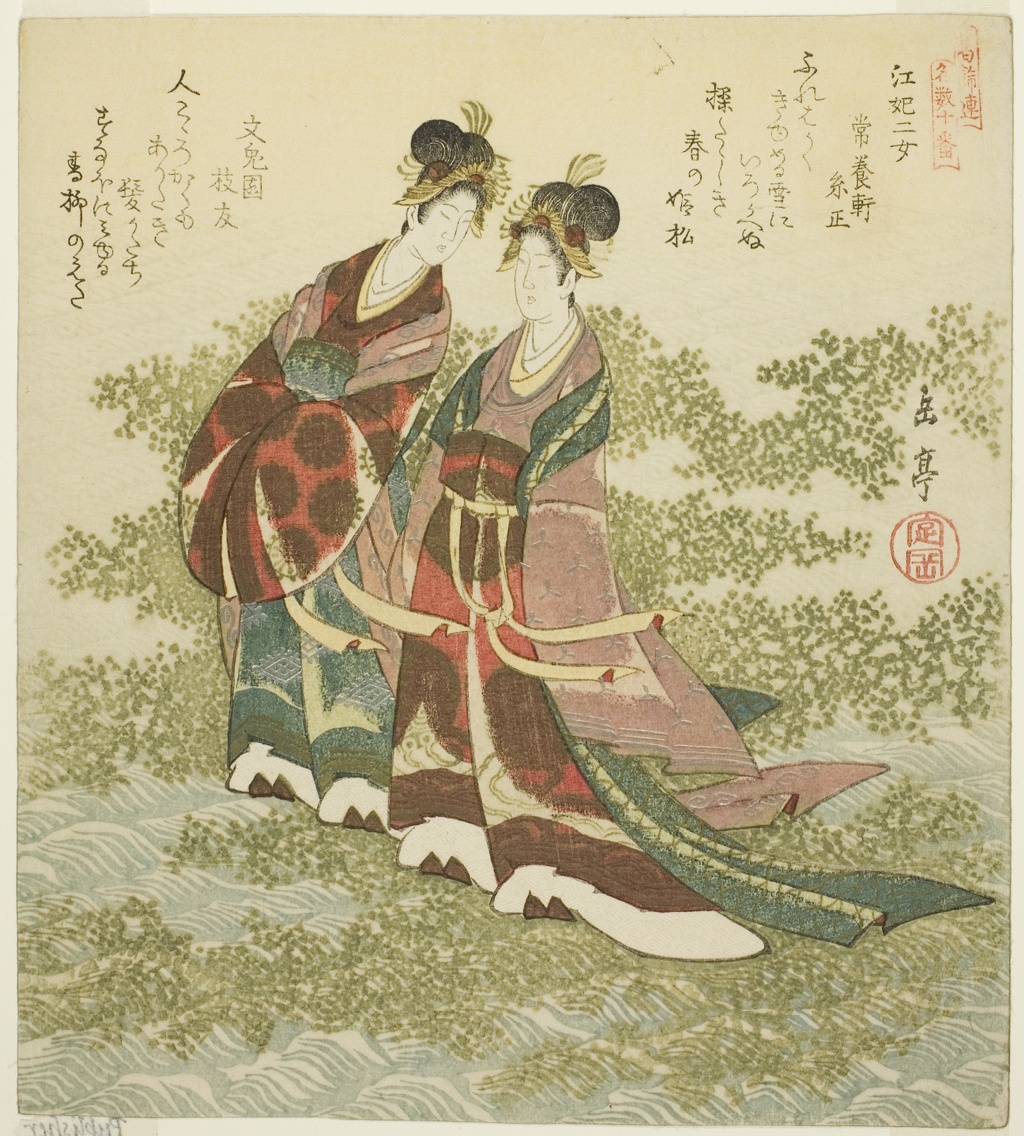
Two Princesses of the River (Kohi nijo), from the series "A Set of Ten Famous Numbers for the Katsushika Circle (Katsushikaren meisu juban)"
| Title | Two Princesses of the River (Kohi nijo), from the series "A Set of Ten Famous Numbers for the Katsushika Circle (Katsushikaren meisu juban)" |
|---|---|
| Artist | Yashima Gakutei Japanese, 1786 (?)-1868 |
| Date | c. 1828 19th century |
| Medium | Color woodblock print; shikishiban, surimono |
| Classification | woodblock print |
| Origin | Japan Japan |
| Holding institution | Art Institute of Chicago |
| Credit line | Clarence Buckingham Collection |
| Rights | Public domain (CC0). Free to use for any purpose. |
About this artwork
“Two Princesses of the River (Kohi nijo), from the series "A Set of Ten Famous Numbers for the Katsushika Circle (Katsushikaren meisu juban)"” is a work by Yashima Gakutei Japanese, 1786 (?)-1868, dated c. 1828. It is executed in color woodblock print; shikishiban, surimono and classified as woodblock print. This work is in the public domain (CC0), so the image may be downloaded and reused for any purpose without permission (see the licence note below).
Explore the context
The artist
This work is attributed to Yashima Gakutei. Browse every catalogued public-domain plate by this maker.
The medium
Catalogued as woodblock print. See other public-domain works in the same medium, all free to download and reuse.
The period
Dated to c. 1828. Explore the wider set of works from the 19th century held in the archive.
The collection
Made available through the Art Institute of Chicago open-access programme, which explicitly places this work in the public domain.
Keep exploring
By the same hand
- New Year’s Sake By the same artist
- The Seven Sages of the Bamboo Grove (Chikurin shichiken), from the series "A Set of Ten Famous Numbers for the Katsushika Circle (Katsushikaren meisu juban)" By the same artist
- The Filial Son of Kamakura from the Collection of Stone and Sand (Kamakura koshi, Shasekishu), from the series "Twenty-four Japanese Paragons of Filial Piety for the Honcho Circle (Honchoren Honcho nijushiko)" By the same artist
- The Filial Child from Shinano Province from the Collection of Stone and Sand (Shinano koji, Shasekishu), from the series "Twenty-four Japanese Paragons of Filial Piety for the Honcho Circle (Honchoren Honcho nijushiko)" By the same artist
- Satsuma no Fukuyorime from the Veritable Records of Emperor Montoku (Satsuma no Fukuyorime, Montoku jitsuroku), from "Twenty-four Japanese Paragons of Filial Piety for the Honcho Circle (Honchoren Honcho nijushiko)" By the same artist
- The Filial Son of Yoro from the Ten Moral Lessons (Yoro koshi, Jikkinsho), from the series "Twenty-four Japanese Paragons of Filial Piety for the Honcho Circle (Honchoren Honcho nijushiko)" By the same artist
- Nibu Hiroyoshi from the Veritable Records of Three Reigns (Nibu Hiroyoshi, Sandai jitsuroku), from the series "Twenty-four Japanese Paragons of Filial Piety for the Honcho Circle (Honchoren Honcho nijushiko)" By the same artist
- Hojo Tokiyori, from the series "Twenty-four Generals for the Katsushika Circle (Katsushika nijushisho)" By the same artist
Zoom out
- /browse Browse the whole archive
Download this image
Rights: Public Domain — CC0 via the Art Institute of Chicago Open Access programme.
This work is in the public domain. You may download the image and use it for any purpose, personal or commercial, without permission or payment. No attribution is legally required, though a credit to Art Institute of Chicago is appreciated.
Prefer a themed set as a single ZIP with a manifest? See the image packs. The works remain public domain / CC0 whichever way you take them.
US vs EU note: in the United States a faithful photographic reproduction of a public-domain 2-D artwork carries no new copyright (Bridgeman v. Corel), which is the basis of these open-access programmes. EU Directive 2019/790 Art. 14 similarly provides that reproductions of public-domain visual works are not protected. If reusing commercially in another jurisdiction, satisfy yourself of the local position. See the full licence note.